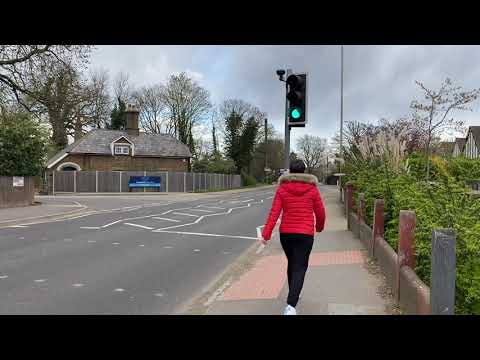
🚸 Priorities and vulnerable road users
Who goes first at roundabouts, junctions and crossings, how to react to emergency vehicles and buses, and how to protect pedestrians, cyclists, riders and animals.
Priority rules decide who goes first. But remember: the law never gives anyone the right to cause a crash. If someone else makes a mistake, you are still expected to avoid it if you can.
Roundabouts
Traffic goes round clockwise. On approach you give way to traffic coming from your right, which is already on the roundabout, unless signs or traffic lights tell you otherwise. Once you are on, you have priority over vehicles waiting to enter. Mini roundabouts follow the same rule.
Junctions
- At a STOP or GIVE WAY sign or line, you give way to all traffic on the major road.
- When turning right across the road, give way to oncoming traffic going straight on or turning left.
- When turning into a side road, give way to pedestrians who are already crossing it.
- At unmarked junctions, nobody has automatic priority: slow down, look, and proceed with great care.
- Traffic lights and police officers' signals override signs and markings.
Pedestrian crossings
| Crossing | What to do |
|---|---|
| Zebra (black and white stripes, flashing amber beacons) | Stop for pedestrians who are on the crossing or clearly waiting to cross. Be ready to stop; never overtake within the zig-zags. |
| Pelican / signal-controlled | Obey the lights. On flashing amber, give way to pedestrians still on the crossing, then go if it is clear. |
- About 50 m before lights or a zebra: check your mirrors and cover the brake (foot ready).
- If people are crossing: stop smoothly before the line, apply the handbrake and select neutral.
- Wait until they have reached the other pavement. Do not wave them across or hurry them (don't rev the engine).
- Check mirrors and blind spots, then move off.
Emergency vehicles
Ambulances, police and fire engines using blue lights and sirens need a clear path. Stay calm, find out where they are coming from, and pull over to the left safely when you can. Do not stop on a bend or crest, do not mount the kerb dangerously, and do not cross a red light or enter a yellow box to let them through. Once they pass, check for a second emergency vehicle before moving off.
Buses
- When a bus signals to pull out from a stop in a built-up area, give way to it if you can do so safely.
- Watch for passengers stepping out in front of or behind a stopped bus.
- Bus / priority lanes are for public transport, cabs, bicycles, motorcycles and emergency vehicles during the times shown. Cars must stay out except to cross them to turn where markings allow.
Pedestrians, children and the elderly
Pedestrians are the most vulnerable. In narrow Maltese streets they often walk on the road because pavements are blocked. Slow right down near schools, bus stops, shops and parked cars. Children can run out between cars without looking; a ball rolling into the road may be followed by a child. Elderly people may cross slowly and misjudge your speed. People with white canes, guide dogs or wheelchairs need extra time and space.
Cyclists and motorcyclists
Give cyclists at least 1.5 m when passing them (more at higher speed or in wind). If you cannot, stay behind until it is safe. Check for cyclists and motorcyclists before turning left (they may be coming up on your left) and before opening your door. Motorcycles filter between lanes and are easy to miss at junctions: look twice.
Animals and horse cabs
In Malta you meet horse-drawn cabs (karozzini), horses being exercised on country roads, and sometimes goats or dogs. Pass slowly and wide, do not sound the horn or rev the engine, and be prepared to stop. A frightened horse can jump into your path.